


Alliance Churches in Africa Unite to Advance the Mission and Strengthen Leadership
Related News
Nepal Flood Response: The Alliance in Nepal Stands with Affected Communities
Men From Across Africa Gather in Mali to Strengthen Men’s Ministry
From Fire to Mission: A Generation Rises at IGNITE Paris 2026
When the Earth Shook, the Church Opened its Doors in Colombia
Alliance churches in Africa are demonstrating unity through shared leadership, growing partnerships, and expanding outreach to more than 2.7 million people across the continent.
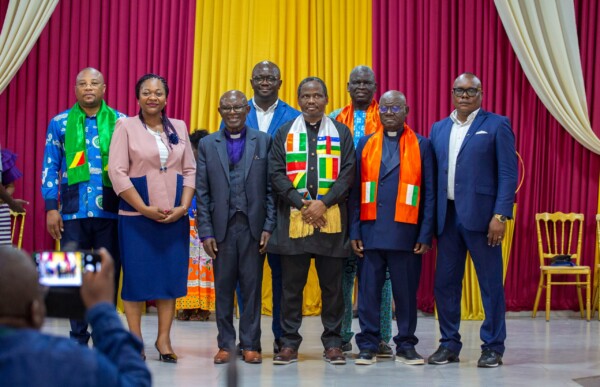
Pastors, church leaders, and delegates from across Africa gathered in Libreville, Gabon on March 1, 2026, for a moment that reflected more than a leadership transition. The gathering became a visible expression of the unity, mission, and shared commitment that define the Christian and Missionary Alliance (C&MA) continent-wide.
Representatives from multiple nations stood together to affirm a collective calling: to work as one body in advancing the gospel in Africa and beyond.
This gathering also reflected a broader reality. Across Africa, Alliance churches are growing in both number and cooperation. According to 2024 data, the Alliance includes 7,679 established churches and 1,367 developing congregations serving more than 1.5 million baptized members and nearly 2.7 million people in their wider communities.
Behind these numbers is a shared vision. From countries such as Cote d’Ivoire and the Democratic Republic of Congo to smaller and developing church networks, the Alliance continues to expand its reach while remaining connected through common mission priorities.
The Christian and Missionary Alliance Church of Gabon, established in 1933 and now present across all nine provinces, reflects this same commitment. Like many national churches, it is not only focused on local ministry but also actively engaged in mission work beyond its borders.
Throughout the gathering, leaders emphasized that the strength of the Alliance church in Africa is found in its unity. Churches are increasingly working together—sharing resources, building partnerships, and supporting one another in evangelism and discipleship.
This collaboration is also seen in mission efforts. In 2024 alone, African Alliance churches sent 248 missionaries, with 28 serving internationally and 217 working within their own countries. Several national churches are already supporting mission fields in other African nations, contributing to church planting and leadership development across borders.
This reflects a shift in which African churches are not only participating in missions but actively leading them.
Another sign of this shared commitment is an investment in leadership. Across Africa, 30,490 ministry leaders and 3,355 ordained pastors serve local churches, supported by 10,890 national workers.
Training remains central to this effort. With 31 theological schools, 1,190 students, and 611 participants in extension programs, the Alliance continues to equip leaders who can serve effectively in diverse settings.
During the gathering, leaders highlighted the importance of strengthening churches from within—ensuring that growth is sustained through trained and faithful leadership.
Key voices during the event pointed to the deeper meaning behind the moment. Rev. Victor Ndoukou, who officiated part of the gathering, emphasized the responsibility of leadership within the wider Alliance family. Ndoukou said the ceremony carried importance for several reasons:
- Official Recognition: It formally established the position, role, and term of office of the individuals and entire leadership team.
- Approval and Recognition: It symbolized peer approval and formal recognition of the role, often described as a form of commissioning or anointing.
- Biblical Foundation: The practice is supported by biblical examples, such as God appointing Joshua to succeed Moses, and Paul instructing Titus to appoint leaders to their offices.
As a matter of fact, leaders also recalled the biblical foundation of such moments, drawing from Joshua 1 and the call to be strong and courageous in following God’s direction.
Rev. Ferdinand Sangoye, AWF’s Africa Regional Coordinator, addressed the assembly, pointing to the importance of partnership among churches and the need to continue strengthening both mission and fellowship throughout Africa. “Much has been accomplished, but much remains to be done,” he said.
He also reminded the church that the mission is shared, not individual. “This mandate belongs to the church,” Sangoye said.
While the gathering included Rev. Ferdinand Sangoye’s formal installation as the president of the C&MA Church of Gabon (Église de l’Alliance Chrétienne et Missionnaire du Gabon – EACMG) and as the AWF Africa Regional Coordinator, its significance extends beyond a single event or national context.
It represents the unity of the Alliance World Fellowship (AWF) in Africa—a network of churches committed to working together to bring the gospel to those who have not yet heard, while strengthening believers and communities.
It also reflects a growing reality: African churches are increasingly shaping and carrying forward the mission of the global Alliance.
Through partnership, leadership development, and mission engagement, the Alliance in Africa continues to move forward as one—serving with a shared vision and a common purpose.